Other Poker Variations

We have gone over the basic set of rules, strategies and tips for a number of the most popular variations of poker such as Texas Hold’em, 5 Card Stud, 7 Card Stud, Omaha Poker, Red Dog Poker, Deuces Wild, Poker Pai Gow, Jack or Better Poker, and Caribbean Poker.

There also exist several other variations of poker that are possibly available online. Our information is based on the most well known and popular versions of the game.

Caribbean Poker

About

Caribbean Stud poker is one of the most popular forms of poker played in the Caribbean Island and on cruise ships.

The game is not a competition between players. It is played between a participant and the dealer to see who has the highest ranking hand.

Everyone around the table receives five cards. The dealer places four of his cards faced down and one card faced up. The players need to decide whether to place a bet or fold according to what chances they think they stand of beating the dealer’s hand. When winning a sum will be given to the player in accordance to the quality of his hand.

How to play the game

The game begins with every player placing an ante (a fixed wager).
Then, the dealer gives out five cards to every player, including himself. One of the dealer’s cards is put on the table faced up, and the rest are put faced down.

The players look at their personal cards and try to decide whether they have a chance of beating the dealers hand. If a player thinks his chances are low, he can fold. A fold makes the player lose his ante for good. If a player wants to have a go at winning, he must bet double the amount of the ante.

After all the bets are made, the dealer unfolds his cards. If the dealer’s hand is lower than a single Ace and King hand, the players win automatically. They will get back their ante and bet plus a sum equal to the ante.

If the dealer’s hand is higher than an Ace/King single, the two hands will be compared. If the dealer has the higher ranking hand, the player loses both his ante and his raise. If, however, the player has the higher ranking hand, he will get back his ante, plus a sum equivalent to the ante, plus a payoff according to the following chart:

Hand Payoff
Royal flush 100 to 1
Straight flush 50 to 1
Four of a kind 20 to 1
Full house 7 to 1
Flush 5 to 1
Straight 4 to 1
Three of a kind 3 to 1
Two pair 2 to 1
Pair 1 to 1
Ace/King 1 to 1

History

The origin of Caribbean poker is, how surprising, in the Caribbean Islands. It was played both on the Islands and on cruise ships that went to and from the Islands.

When casinos in Las Vegas started playing Caribbean poker, they added the progressive Jackpot bet to attract more players. It has since become part of other gambling scenes, like in Nevada.

Caribbean poker is actually a version of a three card game played in Europe in the 16th century, called “Primera” in Spanish. In Primera players would bet on the rank of their hand, which could have been a pair, three of a kind or three of the same suit (called “flux”, or today flush).

In the !8th century, Primera influenced and was influenced by other famous card games: the English Brag. The German Pochen and the French Poque. It is then that those games became five-card games who use bets and bluffing.

The French who came and settled Louisiana brought the game to America sometime in the 18th century, and from Louisiana it spread along the Mississippi and into the West. Later on it became one of the leading games of classical Western movies.

In America the game was played with a full deck, not including jokers. Descriptions of the game can be found in game books starting from the mid 19th century.

Both the number of betting rounds and the ranking system have altered through the years. Straight and Flush hands were incorporated to the ranking system later than the other hand ranks.

Strategy

The only decision a player has to make in a game of Caribbean poker is whether to fold or raise after he has received his hand. We would recommend to you the following strategy guidelines.

  • If your hand is lower than an Ace/King, fold it.
  • If you have a hand of one pair or higher, call a bet.
  • This is true also if your pair is relatively low. (You stand a 42% percent chance to get a pair every round.)
  • If you have an Ace/King hand or higher plus a card that is similar to the dealer’s face up card, call a bet.
  • If you have an Ace/King hand you should bet and not fold if:
    A. the dealer’s up card matches your card, and is in the ranking range of 2 to Queen
    B. the dealer’s up card is an Ace or a King and you are holding a Queen or a Jack.
    C. the dealer’s up card doesn’t match your cards, is lower than the your fourth highest card and you are holding a Queen or higher.

Statistics chart for Caribbean poker

If you are interested in strategy statistics, take a close look at the following chart.

Strategy Total loss House edge Element of risk
Perfect strategy 1,041,372,912,372 5.22% 2.56%
Three rules of thumb (above) 1,041,417,758,724 5.23% 2.55%
Raise on ace/king/jack/8/3 or better 1,059,715,400,580 5.32% 2.60%
Raise on any pair or better 1,090,272,101,460 5.47% 2.74%
Raise on any ace/king or better 1,132,600,203,540 5.68% 2.67%
Playing blind (raise on everything) 3,310,360,338,060 16.61% 5.54%
Matching rank 1,063,176,931,284 5.33% 2.62%

Chart explanations:
“House Edge”: The ratio of the average sum which is lost to the initial bet. Raises do not count in the ratio.
“Element of Risk”: The ratio of the average sum which is lost to the total sum of bets (including raises).

Notice that in perfect strategy the house edge is 5.224% where as the element of risk is 2.555%.

The Progressive Jackpot Side Bet

Caribbean poker offers the players to place a side bet of $1 dollar, which goes into a Jackpot that can be won if a player receives a hand rank of Flush or higher. This winning sum is called progressive payout schedule. We would advise you to make this bet only when the size of the pot is big enough to make the risk worth your while.

If two players have Royal Flush hands (a very rare occasion), there are two ways to go about it. The first is to simply split the pot between them, fifty-fifty. The second way is to give the Jackpot to the player sitting closest to the left of the dealer, leaving the other player the sum of money that the Jackpot will be re-seeded with by the casino. This sum is not small – it may be $10,000 or even $20,000 dollars.

If two players have Straight Flush hands, the player sitting closer to the dealer’s left will receive 10% percent of the meter and the other player will receive 10% percent of what is left.

One thing is clear: if you can sit closer to the left of the dealer, make a go for it!

Jackpot Side Bet Payoff Chart

Different games have different payoff charts, however all of them progress from paying 10% for a Straight Flush to paying 100% for a Royal Flush.

Table 1 Table 2 Table 3 Table 4 Table 5 Table 6
Royal flush 100% 100% 100% 100% 100% 100%
Straight flush 10% 10% 10% 10% 10% 10%
Four of a kind $100 $150 $500 $500 $500 $500
Full house $75 $100 $100 $150 $75 $100
Flush $50 $50 $50 $75 $50 $75

Casino Chart

These are the casinos that play by the different tables*:

  • Table 1: Ballys, Paris, California, Las Vegas Club, Hilton
  • Table 2: Luxor, Excalibur, Mandaley Bay, Monte Carlo
  • Table 3: Bellagio, Venetian, Rio, Every casino in Atlantic City, Casino Niagara (Niagara Falls, Ontario), Grand (Tunica), Gold Strike (Tunica), Ballys (Tunica), Sheraton (Tunica), Isle of Capri (Tunica), Hollywood (Tunica), Harrah’s (Tunica)
  • Table 4: Harrah’s, Circus Circus
  • Table 5: Flamingo Hilton
  • Table 6: Imperial Palace, Horseshoe (Tunica)

If not stated otherwise, the casino is in Las Vegas.

A Jackpot’s Meter

Jackpots have a “meter”, of usually 70-75% percent. This means, for example, that for every 1$ bet made $0.71 goes to the Jackpot and $0.29 is collected by the casino. This is not the casino’s profit: the payoffs are paid out of the meter, so eventually that money is won back by the players.

When a player with a Royal Flush scoops the pot, the casino will automatically put in the Jackpot $10,000 dollars (know as the “seed”). The meter enables this action.

It is important to remember that though 25-30% percent of every bet is collected by the house, the house will need to seed the Jackpot only on the rare occasion of a Royal Flush. (In all other situations winning players will receive only part of the Jackpot.)

Payoffs Chart

This chart shows different payoff tables. (The letter J refers to the Jackpot meter.)

  • Table 1: (598,600 + 7.6 * j) / 2,598,960
  • Table 2: (723,400 + 7.6 * j) / 2,598,960
  • Table 3: (941,800 + 7.6 * j) / 2,598,960
  • Table 4: (1,256,700 + 7.6 * j) / 2,598,960
  • Table 5: (848,200 + 7.6 * j) / 2,598,960
  • Table 6: (1,069,500 + 7.6 * j) / 2,598,960

Average Return Jackpot Meter Chart

This chary shows the Jackpot level in comparison with different rates of return.

Table 1 Table 2 Table 3 Table 4 Table 5 Table 6
25% 6,729 -9,692 -38,429 -79,863 -26,113 -55,232
30% 23,827 7,406 -21,331 -62,765 -9,015 -38,133
35% 40,926 24,505 -4,232 -45,666 8,084 -21,035
40% 58,024 41,603 12,866 -28,568 25,182 -3,936
45% 75,123 58,702 29,965 -11,469 42,281 13,162
50% 92,221 75,800 47,063 5,629 59,379 30,261
55% 109,319 92,898 64,162 22,727 76,477 47,359
60% 126,418 109,997 81,260 39,826 93,576 64,457
65% 143,516 127,095 98,358 56,924 110,674 81,556
70% 160,615 144,194 115,457 74,023 127,773 98,654
75% 177,713 161,292 132,555 91,121 144,871 115,753
80% 194,812 178,391 149,654 108,219 161,969 132,851
85% 211,910 195,489 166,752 125,318 179,068 149,949
90% 229,008 212,587 183,851 142,416 196,166 167,048
95% 246,107 229,686 200,949 159,515 213,265 184,146
100% 263,205 246,784 218,047 176,613 230,363 201,245
105% 280,304 263,883 235,146 193,712 247,462 218,343
110% 297,402 280,981 252,244 210,810 264,560 235,442
115% 314,501 298,079 269,343 227,908 281,658 252,540
120% 331,599 315,178 286,441 245,007 298,757 269,638
125% 348,697 332,276 303,539 262,105 315,855 286,737

Tips

Many Caribbean Poker players incorrectly advise that A-K-J-8-3 is the borderline hand for raising on an ace/king. The advice they give is to raise with this hand or better and fold with less, ignoring the dealer’s up card. In fact it is unwise to ignore the dealer’s up card. If you had this hand and the dealer had a queen showing your expected loss would be 1.17108 units, which is much worse than losing 1 unit by folding.

Many question have been asked about ‘playing blind’ or always raising regardless of what your hand is. This is not an advisable strategy if you don’t have a qualifying hand! The dealer will qualify 56.3% of the time, thus the expected return by raising when you have nothing is .563*(-3) + .437*(+1) = -1.252 which is much less than the -1 you would have by folding.


Jack Or Better

About

The object of Jacks or Better is to obtain a five-card poker hand that contains a winning combination (see the pay table on the machine).

The better your hand is, the bigger the payout. You choose how many and which of your cards are to be replaced. You may replace your cards only once.

How to play

The player aims to get the best hand possible. The payoffs are marked right on the face of the Video Poker machine. Betting is pretty straightforward. On any given machine you can typically choose $0.25, $0.50, $1, or $5 games. And the bets are 1x, 2x, 3x, 4x, or 5x (or maximum bet) whichever game you’re playing. So if you’re playing a $1 game, you can place bets of $1, $2, $3, $4, or $5.

If you bet 5 coins, all winning hands are paid out multiplied by a factor of 5 (except for the royal flush). This is a bonus amount designed as an incentive to play five coins. And those players who don’t play the maximum coins are just setting up the best payoffs for those who do.

It is very important to know that the payoff ratios vary from game to game. Jacks or Better may pay 25:1 for Four Of A Kind. These ratios do not necessarily reflect the true odds, so knowing your game helps you play smarter.

Strategy

Keep any hand that already pays. Possible exceptions, in decreasing value, are:

  • Hold four card Royal Flushes to make Straights or Flushes.
  • Four card straight flushes, inside or outside.
  • High card Pairs rank here.
  • Three card Royal Flushes.
  • Four card Flushes.
  • Low Pairs rank here, trying to build Three Of A Kind.
  • Four card Flushes.
  • Four card Straights. Hold inside Straights only if you’ve got three or more high cards (J, Q, K, A).

Follow this general strategy in order of preference:
Keep any two suited high cards. Discard unsuited high cards.

Four mixed-suit high cards:

  • Keep any three suited, toss the unsuited.
  • Otherwise, keep them all.

Three unsuited high cards:

  • Keep all three of K-Q-J.
  • With A-K-J or A-Q-J, discard the A.

Keep any two unsuited high cards.
Keep any single high card.

Tips

The first thing to note is that the game face shows you the payoff for each betting level. Invariably playing maximum bet pays off better, overall, than any of the lower multiples. Smart players pick the betting level they are comfortable with and choose their game accordingly.

Those players who don’t play the maximum coins are just setting up the best payoffs for those who do.

if you are comfortable with a $5 bet, then pick a $1 machine and play at maximum bet for $5. In either case, you are getting the best payoff odds you can for that game.

Pai Gow Poker

About

Pai Gow poker is a poker game which combines poker and the game Pai Gow, which used to be played with special dominos and dices. Pai Gow is an ancient Chinese game, full of symbols and fascinating enigmas. Games combining poker and Pai Gow seem to have started forming in the mid 19th Century. Only a hundred and more years later, in the 80’s, has Pai Gow poker appeared in Californian card-rooms. The Las Vegas casinos adopted the game the following year, and casinos elsewhere have followed since.

Pai Gow is a “one on one” game, in which a player does not play against the other players around the table but against the dealer. Each player, including the dealer, receives seven cards. With these he must make up two hands, one hand consisting of five cards and the other consisting of two cards. The aim in the game is to have two hands that are higher ranking than the dealer’s two hands.

The ranking of hands is Pai Gow is similar to the regular poker ranking. The game is played with 52 regular cards plus one joker. The joker can function as a limited “wild card”: it can either replace an Ace or replace any card that completes a hand to be a straight, straight flush or royal flush. Pai Gow is played on a Black Jack sized table. There is a maximum of six players to a game.

Perhaps due to its Far Eastern roots, Pai Gow is a relatively slow game, different from most speedy casino games. It is a game easy to learn and know well. You don’t need to have large amount of money to join a Pai Gow game. It is a game of low money risk: you will never lose huge sums of money in Pai Gow. On the other hand, your winnings will not be huge as well.

How to play the game

The game of Pai Gow starts off with a wager. Every player places the chip in front of his seat.

Then the dealer gives out seven cards to each of the players and to himself. To decide which player is first to get the cards either a dice or a random number is used.

Once a player has his seven cards, he needs to break them up to two hands: a five-card hand, called the “high” or the “back”, and a two-card hand, called the “low” or the “front”. The high hand is ranked like in regular poker, with one exception: an Ace-5 straight is considered the second highest ranking straight (the first being Ace – 10 and the third King – 9). The low hand can either be a pair or singles, with 2-3 as lowest rank and Ace-Ace as highest rank.

The players must organize their hands in such a way that the five-card hand ranks higher than the two-card hand. For instance, if a player receives a pair of three and a pair of eight he may not make his two-card hand a pair of eight. If a player does not follow this rule, his hands will automatically lose.

After the players finished organizing their cards, the dealer turns over his cards and organizes them in accordance to a set of rules called “the house way”.

Each player compares his two hands to the dealer’s two hands. There are several possible outcomes:

  1. If both of the player’s hands are higher than both the dealer’s hands, he wins the game.
  2. If both of the player’s hands are lower than both the dealer’s hands, the dealer wins and the player loses his wager.
  3. If the player wins one hand and loses the other it is called a “push”, and no money will be won or lost.
  4. If one or both hands tie, it is called a “copy”, and the dealer wins the hand.

If two hands are four of a kind, the hand with the highest ranking four of a kind card is the winner. For example, if the banker has a Jack four of a kind and the player a King four of a kind, the player’s hand wins.

If two hands are a full house, the hand with the highest ranking three of a kind is the winner. For example, if the dealer has three Aces and a pair of 8 and the player has three Queens and a pair of 10, the dealer’s hand wins.

Because many hands are push hands, casinos don’t make much money from Pai Gow games. One way of tackling this “disadvantage” is by setting a 5% percent commission, paid to the house at every winning hand. Some casinos will deduct that amount on the spot, so the player will automatically receive 95% of his winning pot. Other casinos keep records of winning hands and charge a player only after he leaves the poker table.

An Example of a Pai Gow Hand

Using an example of a hand might help understanding how the game works and what are the possible strategies when playing it.

Let’s say that you are dealt the following cards, as shown in the picture:
Ace of Hearts, joker, 9 of Clubs, Queen of Hearts, 10 of Clubs, Queen of Diamonds and King of Hearts.

You have the following options of compiling two hands:

  1. Back: Pair of Aces (using the joker), pair of Queens and a 9. Front: A king and a 10 (high cards) With this combinations you have a good chance of beating the back hand but a low chance of beating the front hand. The chances you have of losing the game or winning the game are both relatively low.
  2. Back: Pair of Aces (using the joker), King, 10, 9. Front: Pair of Queen. With this combinations you have a good chance of beating the front hand but a low chance of beating the back hand. Again, the chances you have of losing the game or winning the game are both relatively low.
  3. Back: 9-King Straight (using the joker as queen) Front: Ace and Queen With this combinations you have an excellent chance of beating the back hand band a pretty good chance of beating the front hand. This would probably be your best shot.

Pai Gow Strategy

  • Players that are use to regular poker and play Pai Gow poker tend to forget that in this game you win the pot only if both your front and your back hands are winning hands. Getting all excited over having a royal flush is nice, but if your two-card hand is 2 and 3, you will not win the pot. If, for example, you have a pair of 8 and a Jack three of a kind, they should be split up between the two hands, even though by doing so you lose a full house hand.
  • When having the option of making two average ranked hands or one strong hand and one weak hand, the second option might be wiser to take. This way you are playing it safe, because chances are it will be a push, and you won’t lose your money. Go for the two average hands, the bigger the chances of losing that hand.
  • A pair in the low hand and a three of a kind in the high hand will usually win the game. The higher these cards rank, the smaller the chances that the dealer hands will beat your hands.
    On average, a player who plays ten hands of Pai Gow will win three hands, lose three hands and push four hands. (This assuming that he knows how to play the game correctly!)

More about Pai Gow

The Dragon Hand

A possible twist to the game is to use a “dragon” hand. The dealer deals out a hand to an empty seat. Any player may choose to take that hand and play it. That player plays both hands, and by doing so he increases his possible gains as well as his possible loses.

The Banker

Pai Gow offers the option of having a player be the banker. The other players, including the dealer, play their hands against the banker’s hands. The banker scoops the pot in case of a tie, pays from his own money to winning players and collects any lost bets.

Sometimes the role of banker in a Pai Gow game is rotated amongst the players. If there are six players playing (a full table) plus one dealer, each player will get to be the banker every seventh play. Other games deal out the banker position by zigzagging back and forth from the dealer to the players. A player cannot act as banker if he did not play at least one hand where the dealer was the banker. Some casinos offer the option of “co-banking”, a player and a dealer who bank together, splitting between the costs and the prizes.

The banker is the person with the highest odds of winning money. His advantage over the other players is clear: in a “copy” situation, he will win the pot. However, the banker is also the player who risks the most money. In order to become a banker a player must have enough money so that he is able to pay off everyone’s bets.

House Edge Chart

Possible Outcomes in Pai Gow Poker

Outcome Probability
Player wins both 28.55%
Tie 41.47%
Banker wins both 29.98%

Pai Gow Poker Index Values Chart

This chart shows the chances of different hand combinations of winning the game.

5-Card Hand 5-Card Index 2-Card Hand 2-Card Index
9 high 0.0002 2-Mar 0.0007
10 high 0.0018 2-Apr 0.0021
Jack high 0.0081 3-Apr 0.0034
Q-5 0.0086 2-May 0.0046
Q-6 0.0108 3-May 0.0057
Q-7 0.0154 4-May 0.0068
Q-8 0.0209 2-Jun 0.0079
Q-9 0.0247 3-Jun 0.0089
Q-10 0.0257 4-Jun 0.0099
Q-J 0.0257 5-Jun 0.0108
K-5 0.0265 2-Jul 0.0118
K-6 0.0299 3-Jul 0.0128
K-7 0.0374 4-Jul 0.0138
K-8 0.0479 5-Jul 0.0149
K-9 0.0586 6-Jul 0.0164
K-10 0.0654 2-Aug 0.0178
K-J 0.0671 3-Aug 0.0187
K-Q 0.0671 4-Aug 0.0196
A-6 0.071 5-Aug 0.0206
A-7 0.0829 6-Aug 0.0222
A-8 0.1019 7-Aug 0.0259
A-9 0.1245 2-Sep 0.0292
A-10 0.1453 3-Sep 0.0301
A-J 0.1575 4-Sep 0.0309
A-Q 0.1608 5-Sep 0.0319
A-K 0.1608 6-Sep 0.0335
pair of 2’s 0.1729 7-Sep 0.0376
pair of 3’s 0.2048 8-Sep 0.0472
pair of 4’s 0.2377 2-Oct 0.0543
pair of 5’s 0.2716 3-Oct 0.0553
pair of 6’s 0.3067 4-Oct 0.0563
pair of 7’s 0.3432 5-Oct 0.0574
pair of 8’s 0.3842 6-Oct 0.0591
pair of 9’s 0.4274 7-Oct 0.0632
pair of 10’s 0.4691 8-Oct 0.073
pair of jacks 0.5125 9-Oct 0.0921
pair of queens 0.564 J-2 0.105
pair of kings 0.6184 J-3 0.1062
pair of aces 0.6852 J-4 0.1073
two pair 3’s high 0.7503 J-5 0.1085
two pair 4’s high 0.7543 J-6 0.1102
two pair 5’s high 0.7601 J-7 0.1142
two pair 6’s high 0.7676 J-8 0.1232
two pair 7’s high 0.7767 J-9 0.1414
two pair 8’s high 0.7867 J-10 0.1729
two pair 9’s high 0.7969 Q-2 0.1931
two pair 10’s high 0.8074 Q-3 0.1945
two pair jacks high 0.8146 Q-4 0.1957
two pair queens high 0.8203 Q-5 0.197
two pair kings high 0.8257 Q-6 0.1989
two pair aces high 0.8261 Q-7 0.2027
three 2’s 0.8286 Q-8 0.2109
three 3’s 0.834 Q-9 0.2269
three 4’s 0.8393 Q-10 0.2551
three 5’s 0.8446 Q-J 0.2994
three 6’s 0.8499 K-2 0.3268
three 7’s 0.8552 K-3 0.3285
three 8’s 0.8609 K-4 0.3302
three 9’s 0.8665 K-5 0.3323
three 10’s 0.8718 K-6 0.335
three jacks 0.8771 K-7 0.3398
three queens 0.8823 K-8 0.3487
three kings 0.8876 K-9 0.3641
three aces 0.8909 K-10 0.3895
straight 2-6 0.903 K-J 0.4291
straight 3-7 0.9105 K-Q 0.4858
straight 4-8 0.9176 A-2 0.5196
straight 5-9 0.9211 A-3 0.5217
straight 6-10 0.9246 A-4 0.5242
straight 7-jack 0.9316 A-5 0.5272
straight 8-queen 0.9385 A-6 0.5312
straight 9-king 0.9453 A-7 0.5378
straight ace-5 0.9522 A-8 0.5483
straight 10-ace 0.9623 A-9 0.5647
flush 6 high 0.9658 A-10 0.5892
flush 7 high 0.9659 A-J 0.6248
flush 8 high 0.9662 A-Q 0.6744
flush 9 high 0.9668 A-K 0.7409
flush 10 high 0.9682 pair of 2’s 0.7899
flush jack high 0.9705 pair of 3’s 0.8116
flush queen high 0.9744 pair of 4’s 0.832
flush king high 0.9804 pair of 5’s 0.8512
flush ace high 0.9974 pair of 6’s 0.8693
full house 0.9984 pair of 7’s 0.8884
four of a kind 0.9995 pair of 8’s 0.9083
straight flush 1 pair of 9’s 0.9268
five aces 1 pair of 10’s 0.9439
pair of jacks 0.9593
pair of queens 0.9726
pair of kings 0.9839
pair of aces 0.9945

Deuces Wild Poker

About

The object of Deuces Wild is to obtain a five-card poker hand that contains a winning combination. The better your hand is, the bigger the payout (see the pay table on the machine). You choose how many and which of your cards are to be replaced. You may replace your cards only once.

Note: in Deuces Wild, the “deuces” are wild – this means that any deuce (ie the two card) stands for any card (just like a joker), hence the name of the game.

How to play

The player aims to get the best hand possible. The payoffs are marked right on the face of the Video Poker machine. Betting is pretty straightforward. On any given machine you can typically choose $0.25, $0.50, $1, or $5 games. And the bets are 1x, 2x, 3x, 4x, or 5x (or maximum bet) whichever game you’re playing. So if you’re playing a $1 game, you can place bets of $1, $2, $3, $4, or $5.

If you bet 5 coins all winning hands are paid out multiplied by a factor of 5 except for the royal flush. This is a bonus amount designed as an incentive to play five coins. And those players who play less than maximum coins are setting up the best payoffs for those who do.

Strategy

Hold any 5 Of A Kind or Royal Flush.
If you’ve got four 2’s keep them!

If you’ve got three 2’s:

  • Hold any made 5 Of A Kind or Royal Flush
  • Otherwise, keep the 2’s and discard the rest.

If you’ve got two 2’s:

  • Hold any made Straight, Five Of A Kind or Royal Flush.
  • Hold any 4 of a Kind.
  • Hold any 4 of a Royal Flush.
  • Otherwise, keep the 2’s and discard the rest.

If you’ve got a single 2, keep any made hand EXCEPT:

  • Hold four card Royal Flushes over made Straights, Flushes and Straight Flushes.
  • Keep four card Straight Flushes of all types.
  • Hold three card Royal Flushes.
  • Do NOT keep two pair, keep only one.
  • Hold four card Flushes.
  • Hold four card Straights.
  • Hold three card Straight Flushes, including gaps.
  • Hold four card inside Straights.
  • Hang on to two card Q or J high Straight Flushes.
  • Discard two card Royal Flushes.
  • If you’ve come this low, discard everything and try again.

Some players are reluctant to throw away five cards, but that is a most important strategy. You want to make room for additional card(s) that could be a deuce(s), and holding that Ace or King is not going to help you if the next hand coming up could be four or five 7’s.

Hard nut Jacks or Better players will throw away complete hands-5 cards only 3% of the time, while Deuces Wild players almost 20% of the time.

Inside straights should be held, if presenting the best possible return from your initial five cards dealt. Therefore, a 5, 6, 8, 9 hand can produce a 7 or wild card in Deuces Wild. Approximately every 5000 hands will hit four deuces – a secondary jackpot that will allow you to pocket some winnings in this game.

Tips

Invariably playing maximum bet pays off better, overall, than any of the lower multiples. Smart players pick the betting level they are comfortable with and choose their game accordingly.

If you are comfortable with a $5 bet, then pick a $1 machine and play at maximum bet for $5. In either case, you are getting the best payoff odds you can for that game.

It is very important to know that the payoff ratios vary from game to game. These ratios do not necessarily reflect the true odds, so knowing your game helps you play smarter.

Red Dog Poker

About

Red Dog poker, also known as “Acey-Deucy”, “Yablon”, “In Between” and “Between the Sheets”, is perhaps the most simplified version of poker. Its rules are few and easy to follow. A hand in this game consists of three cards, there is only one bet that a player needs to decide upon, and it has no element of competition because winning is independent of the other players around the table. The goal of the game is to make a successful bet regarding what range of numbers will the third card rank.

Perhaps do to its uncomplicated nature, Red Dog use to be a very popular poker game in the old West. Today, though it’s still played and is popular in some places, it is not easy to find a game of Red Dog in the casinos. Casinos that offer the game have changed some of the rules of the original game, and it is called there Casino Red Dog. It will usually be played with a single deck of cards or with 6 or 8 decks. Red Dog is played on Black Jack sized tables, and can have up to sixteen players participating.

How to play

The structure of the game

A hand in Red Dog poker consists of three cards, which are dealt 2 and 1. The goal is that your third card will be higher than one of your initial cards and lower than the other.

The game of Red Dog poker starts with each player placing an opening bet. This bet is sometimes referred to as an Ante, though its sum can vary.

After the opening bet the dealer gives out to each player two cards. The important thing is the “spread”, the number of cards that can come in-between those two initial cards. The closer ranking the two cards are, the smaller the chances of winning are – but the bigger the money which can be won.

Following the distribution of the cards the dealer places a mark, which shows the spread and its odds . The player makes his second and final bet, deciding whether he wants to raise or not. If he raises and wins, he can double his money or more, according to the odds. If he doesn’t raise and wins, he will receive his money back.

Then a third card is dealt, determining whether the player had won or lost, and what sum will he rake.

The Hand

A hand of Red Dog poker consists of three cards. An Ace ranks only high, as 14. Suits are not important for the game.

To win a hand of Red Dog poker the third card’s rank must be in the “spread”, or in-between, the first two cards. For example, if you were given a 4 and a 9 and then given a 6, you have won because that number is in-between the ranks of your two initial cards. The spread in this example is 4, and the cards that fall into that are 5,6,7, and 8.

A “consecutive hand” means that the first two cards dealt are in sequence, for instance a 7 and 8. In such a case there is no spread. Therefore the hand is called a “push”, meaning a tie. The player simply receives his bet back from the dealer.

A paired hand, in which the first two cards are identical, also has no spread. In most cases the player will not have to place a bet in order to be given the third card. If that card is similar to the first two, and a three of a kind is formed, then the player has won and will receive the highest value for his money: 11 to 1. If that card is not similar then the hand is considered a push. In some games the player has the option, in a pair situation, to bet on whether the third card will be higher or lower than the pair.

The Betting

The second betting is the only point in the game in which a player needs to make a strategic decision. At the second betting the player may choose to raise, which in a game of Red Dog means to double your first bet.

The amount of money won depends on the spread. A big spread means more chances of winning and therefore a smaller amount will be awarded. Following that logic, a small spread means less chances of winning and therefore a larger amount will be awarded.

A “payout” in Red Dog refers to the possible money gained from a certain hand, according to its spread. When winning a hand, the player receives his original betting plus a payout, according to the following odds:

  • Spread of One / 5:1 payout
  • Spread of Two / 4:1 payout
  • Spread of Three / 2:1 payout
  • Spread of Four to Eleven / 1:1 payout
  • Pair / 11:1 payout (when making a three of a kind)

Strategy

Strategy Charts

Expected Gain by Raising
This chart is meant to show the player his chances of winning a hand in Red Dog poker, played with a six deck

Spread Pay Probability of winning Player’s edge
1 5 0.077419 -0.53548
2 4 0.154839 -0.22581
3 2 0.232258 -0.30323
4 1 0.309677 -0.38065
5 1 0.387097 -0.22581
6 1 0.464516 -0.07097
7 1 0.541935 0.083871
8 1 0.619355 0.23871
9 1 0.696774 0.393548
10 1 0.774194 0.548387
11 1 0.851613 0.703226

As can be seen in the chart, only a spread of 7 and above gives you good chances to win, and therefor worthwhile to raise the bets (regardless of the number of decks which are being used). The chances of winning in a seven or higher spread are more than half, about 54% percent. Winning a spread of 11, the highest spread, gives a chance of 84% percent. The chances of winning bigger payouts with smaller spreads are about 20% percent or lower – rather risky.

House Edge According to Number of Decks

Number of Decks House Edge Element of Risk
1 3.16% 2.67%
2 3.08% 2.61%
4 2.88% 2.45%
6 2.80% 2.38%
8 2.75% 2.34%

Tips

Red Dog poker is a relatively basic game to understand which is probably why it’s so popular. There aren’t many complex rules or strategies to follow. A couple of helpful hints are:

  • Only raise when the spread is seven or more.
  • Look for six deck Red Dog, the game has the lowest house edge when it is played with six decks.

Omaha Poker

About

Omaha is a poker game which combines face-down cards, which are given out to each player, and face-up cards, which are communal.. A hand in Omaha needs to consist of two cards that were given face-down and three cards that were given face-up.

There are four betting rounds in a game of Omaha. Some games of Omaha are played with limits. This section will explain how to play a game of High Omaha, with a limit.

How to play the Game

Button and Blinds

Before a game of Omaha begins, the dealer position needs to be given to one of the players. A round disk called “button” picks the dealer for each hand, so that all the players around the table get to be dealers at some point of the game. The button rotates clockwise.
Once the button has chosen a dealer, “blinds” are posted. These are bets which are made before the cards are dealt to the players. The player sitting to the left of the dealer will post the “small blind”, which will amount to half of the minimum bet. The player sitting left of the small blind will then post the “big blind”, which will amount to the minimum bet.

The Rounds

Once both blinds are posted, the actual game begins. The dealer gives out four cards, faced down, to each of the players. He gives the first card to the small blind, and the last card to himself.
The player on the left of the big blind starts the first betting round. The round goes clockwise, and finishes at the big blind.

The player has the option of calling, thus matching the bet made by the big blind, raising that bet or folding and dropping out of the hand. In Limited Omaha the bets taken on the first and second rounds have a low limit minimum to them, and the bets taken on the third and fourth rounds have a high limit minimum bet.

After the first round of bets is finished, the dealer puts on the table the “flop” cards: three communal cards, put face-up. The player to the left of the dealer starts the second round of bets.

After the second round ends, a fourth community card is put face-up on the table. This card is call the “Turn”. The third round of betting takes place.

Last Round and Showdown

The dealer then deals out the fifth and last card, faced up, otherwise know as the “river”. The number of raises which may be made at the final round is usually limited up to three or four. If, however, it’s a “heads-up” play, meaning that only two players are left. then there will not be a limit to the number of raises.
Following the final bet will be a showdown. The first player to show his hand is always the last player who showed strength when making a bet. A hand of Omaha must consist of two “hole” cards, which were given to the player faced down, and three communal cards, which were set on the board face-up. After the showdown, one player will collect the pot.

Joining a Table

If you wish to join a poker table which is already playing Omaha, you need to put in the pot an amount equivalent to the big blind. After doing this you may join the game, and when it’s your turn to be the big blind you need to bet the same amount again. You also have the possibility of waiting to join in until the position of big blind rotates to your seat. However, if you sit in a game and miss three blind rotations, you will be asked to leave the table.

Strategy

The most important thing to think about in a split pot game is the wide spread in profit between winning just half the pot vs. winning (or “scooping”) it all. – It ends up being a lot more than just double the amount.

Scooping the pot can build a healthy addition to your stack of chips. Getting half hardly puts you ahead of where you were before you started playing the hand.

A skilled Omaha Poker player will usually only play starting hands that have a solid chance of winning both ways.

Omaha is a game of “nuts”. There are numberous players with numerous cards finding so many reasons to play. A final hand with a pretty good high and a fairly good low can easily get clobbered by nut hands both ways. So after the flop or maybe the turn, if it looks like you don’t have an almost certain nut for one end and a good shot at the other, your best bet is to fold up and wait for the next hand.

Tips

A Pair is more of a burden than an advantage. If one of the Pair is a communal card of equal value as one your hidden pocket low cards, this means that your hidden pocket card won’t end up giving you a low-hand advantage.

Even when there are less than four players at the table, you still end up losing money if the pot is quartered.

Decide quickly if you are eligible to play the low hand, and adjust your betting accordingly.

If you have a strong high hand after the flop, it is recommended that you play aggressively right through to the end. This ensures that you have a good chance at taking at least half of the winnings.

Omaha Hi-Lo Poker

Omaha Hi/Lo has become in recent years one of the most popular poker games, due to its fast-action nature and the big pots which can be won in a game.

Omaha Hi/Lo is a form of Omaha poker, in which the pot may be split between two players: the player with the highest ranking hand and the player with the lowest ranking hand. The game is also know as Omaha Eight Or Better, because a low hand should consist only of cards that rank eight or lower. If no player has a qualified low hand, the whole pot is given to the player with the highest ranking hand.

Like regular Omaha, four cards are given to the players face down and five cards are communal cards, put on the table faced up. A hand in Omaha must consist of two face down cards and three face up cards. A poker player may try and win both parts of the pot by succeeding in forming both the high hand and the low hand, using different card combinations.

How to play a game of Omaha Hi/Lo:

Button and Blinds

Before a game of Omaha begins, the dealer position needs to be given to one of the players. A round disk called “button” picks the dealer for each hand, so that all the players around the table get to be dealers at some point of the game. The button rotates clockwise. Once the button has chosen a dealer, “blinds” are posted. These are bets which are made before the cards are dealt to the players. The player sitting to the left of the dealer will post the “small blind”, which will amount to half of the minimum bet. The player sitting left of the small blind will then post the “big blind”, which will amount to the minimum bet. So if you are playing a $5-$10 game, the small blind will be $2.5 and the big blind will be $5.

The Rounds

Once both blinds are posted, the actual game begins. The dealer gives out four cards, faced down, to each of the players. He gives the first card to the small blind, and the last card to himself. The player on the left of the big blind starts the first betting round. The round goes clockwise, and finishes at the big blind.
The player has the option of calling, thus matching the bet made by the big blind, raising that bet or folding and dropping out of the hand. The bets taken on the first and second rounds have a low limit minimum to them, and the bets taken on the third and fourth rounds have a high limit minimum bet. So if you are playing a $5-$10 game, the minimum bet for the first two rounds is $5 and the minimum bet for the last two rounds is $10.

After the first round of bets is finished, the dealer puts on the table the “flop” cards: three communal cards, put face-up. The player to the left of the dealer starts the second round of bets.

After the second round ends, a fourth community card is put face-up on the table. This card is call the “Turn”. The third round of betting takes place.

Last Round and Showdown

The dealer then deals out the fifth and last card, faced up, otherwise know as the “river”. The number of raises which may be made at the final round is usually limited up to three or four. If, however, it’s a “heads-up” play, meaning that only two players are left. then there will not be a limit to the number of raises.
Following the final bet will be a showdown. The first player to show his hand is always the last player who showed strength when making a bet. A hand of Omaha must consist of two cards which were given to the player faced down, and three communal cards, which were set on the board face-up.

After the showdown the pot is either split in two and given to the highest hand and the lowest hand, or, if there is no qualified low hand, it will be given all to the highest hand. A player may try to win both halves of the pot by using different card combinations to compile both the high hand and the low hand.

In case of tied hands, the pot will be split. For example, if there is one high hand and two low hands, the high hand will receive half of the pot and each of the low hands will receive a quarter of the pot. (This is called “getting quartered”, because the player received only a quarter of the pot.)

Joining a Table

If you wish to join a poker table which is already playing Omaha Hi/Lo, you need to put in the pot an amount equivalent to the big blind. After doing this you may join the game, and when it’s your turn to be the big blind you need to bet the same amount again. You also have the possibility of waiting to join in until the position of big blind rotates to your seat. However, if you sit in a game and miss three blind rotations, you will be asked to leave the table. If you put the blind in the pot but “disappear” when it’s your turn to act, your hand will be disqualified and you will not get your money back.

A Qualified Low Hand

A low hand in Omaha Hi/Lo must consist of cards which rank eight or below. A pair disqualifies a low hand. The Ace card, which may be used as the highest card in the deck, may also be used as the lowest card on deck, ranking one. The best low hand in Omaha Hi/Lo is called the “wheel”, and it is a straight of Ace to 5.
If two players show a low hand, the winner is the player who’s highest card is lower. For example, player A has a hand of 7, 5, 4, 3, 2 and player B has a hand of 8, 6, 5, 3, 2. Player A is the winner because his highest card, a 7, is lower than his opponents highest card, an 8.

If two low hand players tie in their highest card, than the next highest card is the deciding card. For example, player A has a hand of 8, 6, 5, 2, Ace and player B has a hand of 8, 6, 4, 3, 2. The first two high cards, the 8 and 6, are tied. So the next high card is the determining card. Player A has a 5 and player B a 4, therefore player B has the winning hand. (Sometimes players get confused in such situations because they see that player A has the lowest ranking card, which is an Ace. So it’s important to remember that the deciding factor is the highest card in the hand, not the lowest.)

7 Card Stud Poker

About

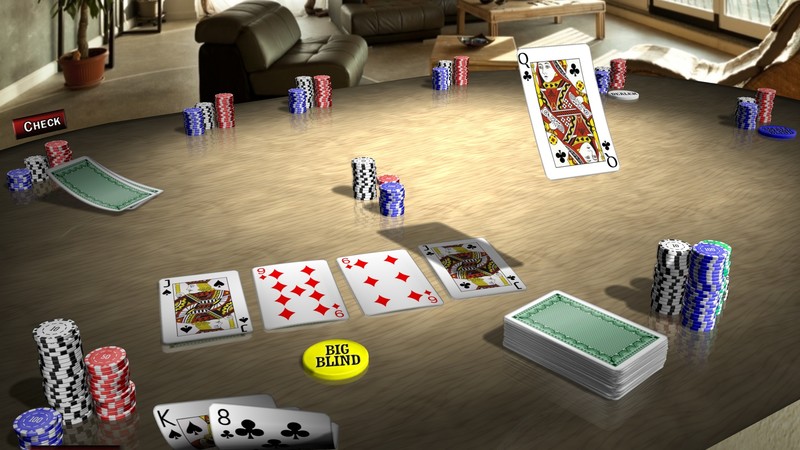
Seven Card Stud poker is one of the most popular forms of poker. Both experienced poker players and beginners enjoy playing Seven Card Stud. As its name indicates, this poker game is played with seven cards. Each of the players receives three cards face down (for your eyes only) and four cards face up, that everyone can see.

All in all there are five betting rounds in Seven Card Stud.
There may be less rounds if before all seven cards are dealt a player makes a bet and no one else calls, in which case he or she will win the pot. A hand in seven card stud is still complied of five cards, and it is up to the player which cards to use and which cards to leave out of the hand.

How To Play the Game

There are five betting rounds in Seven Card Stud. One bet and three raises are allowed in each betting round. Seven Card Stud poker begins with an ante, meaning that each player adds to the pot a fixed sum.

The sum is determined by the poker room or, in a private game, by the participants. Then the dealer begins dealing. Each player receives initially three cards, two face down cards and one face-up card, otherwise known as “up”, “door card” or “Third Street”.

The player who received the lowest up card opens the first round of bets. If two players received the same low ranking up card, then suits determine the round, progressing from clubs, diamonds, hearts, to spades. After the first bet is made each player may call, raise, or fold. This first round of betting is also known as “Third Street”.
After everyone have placed their bets, a fourth card is dealt, face-up. From here on, the betting rounds start with the player who has the highest ranking cards showing either betting or checking. After this the other players in turn choose to call, raise, or fold. This second round is called “Fourth Street”.

After “Fourth Street” a fifth card is dealt, face-up, and a betting round starts. This is called (unsurprisingly) “Fifth Street”.

Next the sixth card is dealt, face-up, followed by a fourth betting round. This is called “Sixth Street”.

The seventh and last card is dealt face down. This card is also called “River Card” or “Seventh Street”. The players then decide which five cards they are going to use, and they make their final bets.

(Stud is limited to eight players. Though chances that all players stay in the game till the last round is slim, if this occurs there won’t be enough cards in the deck to deal an individual card to each player. Instead, there will be one river card, and it will be dealt faced up, for the use of all players.)

At the end of “Seventh Street”, there is a showdown of hands. Wining hand takes the pot. If two hands are tied, suits won’t determine the winner but rather both players will split the pot.

Strategy

  • If you see that another player’s up cards make a stronger hand than your cards, it is best to fold.
  • The most important moment in Seven Card Stud poker is the fifth betting round. If you do not have a strong hand by then, it would be the right time to simply fold. Stay in the game after the fifth round only if you think that you can play your hand until the end of he game.
  • Keep your eyes opened to see if other players received a card that you need in order to complete a hand. If you are playing Stud online, write down the cards that you see, and calculate your chances accordingly. For example: if you are trying to make a full house with a pair of tens and a pair of sixes, and on the table there is one ten and two sixes, there is only one card that can help you: a ten. Your chances are obviously very very slim.

Tips

If you start with a high pair, fast play to get rid of as many players as possible. Slow play starting can draw hands like three to a straight or a flush. The idea is to keep other players in to build the pot.

It’s not wise to begin with a small pair unless they are hidden or your sidecard can beat the board.

It’s not advisable to play three to a low straight or a low flush.

Keep your eye on the board for key cards that can seriously diminish your chances of making a good hand and for opponent’s hands that could pose a threat. Play carefully and fold out early if it looks like things aren’t going to go your way.

Unless you are playing a strong draw hand, it’s advisable to fold if your complete hand can be beaten on the board by another player’s upcards.

It’s good to study your opponent’s moves, particularly when you are not playing hands and can pay closer attention to what’s going on. Do you notice your opponents play more often than they fold? Do they bluff? Can they be bluffed? Do they have any tell-tale signs that give away information about their hands?

It’s good to get caught bluffing every now and then. It’s a sure way to mix up your play and not be too predictable. You can win pots you don’t deserve more easily when your bluffing works. You may lose a few chips in the process but it will get you calls from weaker hands later on when you are really strong and need the action.

The first four cards are the biggest part to winning at Seven Card Stud. If your starting hands develop as you anticipate, you can be a strong favorite to win. If they don’t, you can bail out early in the game and escape the cost of winding up in second place.

Always work on your Poker-face.

Variations of 7 Card Stud Poker

A variation can be an interesting way to renew a game that has been played a lot. Some variations have advantages over regular Stud, such as allowing a larger amount of players and speeding up the game. Each of the variation games that we shall bring here has specific rules, which should be read carefully and understood fully by a new player who joins a game.

Seven Card Mutual

In a game of Seven Card Mutual the face-up cards are not dealt to a player individually but rather are put on the board for everyone’s use. They are called “mutual” cards. Because the face up cards in this game are not given individually but collectively, less cards are needed, and so Seven Card Mutual can be played with up to sixteen players.

Omaha

In Omaha the first betting round takes place straight after the two down cards are dealt (as oppose after the third card, in Stud). This game also involves using mutual cards, put on the board for everyone’s use. The last card dealt is also a mutual card (as oppose to a face down card in Stud). Because there are only two individual, face down, cards, less cards are needed, and so Omaha can be played with up to twenty four players.

Mutual Omaha

This is Omaha with a twist: after the seventh and final card is dealt, before the final betting round takes place, players are offered the option of buying an extra card, faced down. The price of the card is either half the size of the existing pot or, in a low limit game, the exact size of the existing pot.

Amarillo

This game is also very similar to Omaha. The big difference is that in Amarillo a player must compile his hand using his two face down cards and three faced up cards. This rule prevents the situation that occurs in Omaha, in which the pot is split up by all the participants around the table. This happens when the winning five cards are those which are put face up on the table. For example, if the five up cards in Amarillo make a straight flush, it won’t help a player unless he has two hole cards to go with it. However, in a game of Omaha the players don’t have to use their own cards and can simply use the communal cards. Unless one of the players has a high card which will make for a stronger hand (instead of a 7-Jack on the table having a “hole” card of Queen to make a 10-Queen), all the players will use the table cards and will win the pot, which will be split up evenly amongst them.

Stud 8 or Better

Stud 8 or Better is the Hi/Lo version of Seven Card Stud. This means that the pot might be split between two hands: the highest ranking hand and the lowest qualifying hand. In order for a low hand to be qualified it must consist of cards which are eight or lower. If there are two low hands, the hand with the lowest high card wins. If the lowest high card is similar, the next high cards determines the winner. An Ace may be used as a low card, ranking 1. The best low hand, also known as the “wheel” or “bicycle”, is Ace, 2, 3, 4, 5. A straight and a flush don’t count in low hands.

5 Card Stud Poker

About

Five Card Stud Poker is an “oldie”, invented around 1850, though it is still loved and played by many to this day.

It is a relatively simple variation of regular poker, and can be played with between two to ten players.

How to play the Game

At the start of the game each player puts an ante, a prescribed sum of money (or chips).
Then the dealer starts the dealing of two cards per player, one dealt face-up (also known as the “up” card or the “door” card) and the other face down (also known as a “hole” card). There is only one “hole” in five card stud poker, and it will be revealed only at the very end of the game.

The first betting round in five card stud poker is started by the player who received the lowest ranking up card. The player sitting to his or her left make the second betting, and so on, clockwise. The players have the options of calling the opening bet, raising it of folding (dropping out). The betting round is over once betting has equalized, meaning that all of the players remaining in have bet the same sum.

Once the first round of betting is completed, the dealer gives out a third face-up card, and the second round of betting begins. This round, and the next two to follow, are started by the player who holds the highest ranking cards face-up. That player starts the betting at the lower limit, unless he has a pair, in which case he has the option of starting at the higher limit.

After the third betting a forth and a fifth card are dealt, both face up, both followed by rounds of bettings. These rounds are also started with the player which holds the highest card face-up. The bets at this point are at the higher limit. It is important to know that the option of calling is available only during the first and last betting round.

When all the players still remaining in the round have five cards in their hands (four face-up plus one face down) and have placed their bets, they turn their face down cards over. The first player to show his hand is always the person that most recently demonstrated strength with a bet or a raise. The ranking of the hands is identical to the regular ranking hands in poker, and so the winner takes the pot.

Strategy

Take note of your opponents’ visible cards in order to see if you are losing a hand

If the cards you need to help improve your hand are visible in your Opponents hands, assume they are unattainable

There are 13 cards in a suit. You need five of them to make a flush, if the cards you need happen to be in your opponents’ hand you have no chance of them being dealt to you, however, if you can’t see them, it means that it is still possible to pick up those cards

It is recommended that you fold if another player’s exposed cards are very strong

It is recommended that you fold if another player’s exposed cards beat your entire hand

If you are trying to complete a Straight, first check to see if any other player displays the cards you need. You can then alter your strategy accordingly

Fold when needed. 5 Card Stud poker is a game of patience and it’s not worth betting all your money on losing hands.

With 5 Card Stud, patience can be the most valuable virtue!

TIPS – for Five Card Stud poker

  • As oppose to regular poker, most of the cards in this game are exposed. There are clear advantages and disadvantages to playing poker this way. One thing is certain: if your strongest talent in poker is bluffing – this isn’t the right game to put your poker faces into action. Then again, this might be the game to play with people that know you so well that you don’t stand a chance of bluffing them anyway…
  • We would recommend playing Five Card Stud poker also as a stepping stone to playing Seven Card Stud poker. Remember, there’s always more to learn about in the poker world!
  • Make sure that during the game your “hole” card is never exposed. (If you manage to peak at your opponents hole cards, that’s a blessing…)
  • If your hand is definitely weaker than the other players’ up-cards, it is time to simply fold.
  • Constantly watch other peoples cards, and bet accordingly. If you need a certain card in order to complete your hand, say – a Jack to make three of a kind – look around the table and see if perhaps it was already given to someone else.
  • The pot in Five Card Stud poker is won many times by relatively low poker hands, either pairs or high cards.
  • Don’t forget to enjoy yourself 🙂
Texas Hold'em Poker

Texas Hold’em Poker

About

Texas Hold’em poker is probably the most popular form of poker online played today, known in some places as Hold’em, Hold Me, and Hold Me Darling (who comes up with these names?!). It is one of the variations of Seven Card Stud poker, and its relatively simple rules make it possible for beginners to participate in a game. Those familiar with Omaha will find Texas Hold’em to be a stepped-up version of that poker game, having a smaller number of betting rounds. It is a rather quick game, so in order to master it one should practice playing it. One of the advantages of Texas Hold’em is that it enables a larger number of players to participate.

In Texas Hold’em, each player receives at the beginning of the game two cards face-down (for your eyes only). During the game the dealer puts on the table (not all at once) five cards dealt face-up, which are “community” cards. A hand of five poker cards is complied by a combination of the cards which were given face-down to the player and the cards which were dealt face-up (the communal cards). There are four rounds of bettings in Texas Hold’em, and the player with the highest ranking hand takes the pot. If before all rounds are done someone makes a bet which no one else calls, he will win the pot there and then.

How to Play the Game

The first thing to be done in a game of Texas Hold ’em is to decide on the dealer by using a disc called the “dealer button”. Before the dealer starts dealing out the cards a live bet is made by the two players who are sitting to the left of the dealer. Their bets are called “small blind” and “big blind” (It is called A live bet because it is considered part of the bets to come, and it’s called blind because the players haven’t seen any of their cards yet.) The size of blinds may defer from one game to another.

The dealer starts off by dealing two cards face-down to each player (also called “hole” cards). The betting round is opened by the player sitting to the left of the big blind, and it continues clockwise. Players have the option of betting, raising, checking or folding. The “big blind” has the right to be last in the round, and he or she may check or raise the bet.

After the first round of bets are placed, the dealer puts on the table three cards, faced up. These are community cards, also called “flops”. The player to the left of the dealer starts the second betting round. That player will also begin the remaining rounds of bets for that hand. (If he drops out, then the player to his left starts, and so on.)

Once the second round ends the dealer puts a fourth card faced up. This cards is also called the “turn” or “Fourth Street”. Then the third round of betting takes place.

The dealer then turns over the fifth and final communal card, also called the “river” card or “Fifth Street”. After this the players make their final round of betting.

The final round is followed by a showdown. The highest ranking hand takes the pot.

THE STRATEGY – Of holding on to a hand in Texas Hold’em

When to Stay in a game of Texas Hold ‘Em

One of the biggest disagreements that can be found amongst Texas Hold’em players is whether the strength of a hand is determined by the “hole” cards or not. Some would say, and we would have to agree with them, that a player should not place bets unless he has reasonably useful cards to begin with. The chances a player has of starting off with three useless cards and finishing off with a winning hand is, well, zilch, or nearly zilch.

Others would oppose to this statement, and say that when making a five card hand out of seven cards, it really doesn’t matter which cards were given first and which were given last. This claim is, to our opinion, wrong. Though surprises do occur in poker, and the final cards can sometimes make a twist of the game, this happens seldom, and one should not trust his luck so much, especially when there is money at stake. So our tip would be to play a hand only if you were given good starting cards.

Just how good should these starting cards be? That’s a great question, though its answer is kind of complex. First of all, your strategy should take into account whether you are playing a game of high limit or of low limit poker. Secondly, you should take into account the skills of the other players around your poker table. If they are experienced players who are willing to take risks, then you’ll need a pretty good starting point in order to win the pot.

You should also take into consideration that in a game of Texas Hold’em, the average winning hand would probably be three of nine. That means that if you have a pair in your “hole” cards (face-down cards) that is higher than nine, you stand a chance at winning the round. (If that pair is a King or Ace, your chances are obviously higher than if your pair consists of two tens.) If by the second to last round no high ranking cards were dealt face up, you should be suspicious that your fellow players have good hole cards too, and act accordingly.

In order to help you with your decisions, we’ve come up with a list of different possible hands, and advises as to how to take them forward.

Three cards in sequence, of the same suit

Three cards in sequence, of the same suit

If you’ve been good the Gods are smiling to you, you should make a wish for getting three cards of the same suit in sequence. If to be more specific, your best fortune would be to receive a Queen, Jack and ten of the same suit, preferably – a heart.
With this combination of cards you have plenty of combinations possible, depending on the other cards which are dealt face-up. You can make up a Flush with any two cards of the same suit. You can make up a Straight or a Straight Flush of Ace to ten, King to nine or Queen to eight.

You stand less of a chance getting a Straight if your starting point is an Ace, King and Queen of the same suit. Though they are of the highest ranking value, they do not offer the highest chances. Cards which are “skipped”, like a Jack, nine and eight are risky, but you might want to take that risk and aim for a Straight.

If you’re not lucky enough to make a Flush or a Straight, there is still a chance to find two other Queens or Jacks, thus making a strong hand of three of a kind, which stands a chance of winning the pot. You can also make high ranking pairs with your Queen and Jack, which would make a strong two of a pair, which is also a hand worth a shot.

If you’re aiming for a Straight or a Flush and you got one card on the fourth or fifth, it is worth to stay and hope to get your last card on the sixth or seventh.

Three cards of the same suite

Let’s say you have three cards of the same suit: Queen, ten and a five. With the Queen and ten you stand some chance of making a Straight or even a Straight Flush. Having three cards of the same suit also gives you about 20% percent chances of getting a Flush, which you need only two more cards for (as oppose to three more cards for a Straight). Depending on how big the betting sums are, and how tight you are with money, it is recommendable to stay in the game even if the fourth card did not add on to your hand. Some players would quit if the fifth card happened to also be futile.

Three cards in sequence

This situation is similar to the previous one, of three making a flush. Let’s say you have Queen of Hearts, Jack of Spades and ten of Clubs. You have a pretty good chance of making a Straight, and if that doesn’t happen, you can still get high ranking pairs or three of a kind. If you have a Queen of Hearts and a Jack and a ten of Spades that’s even better, because you stand a chance of making a Flush.

Three of a kind

Having three of a kind is great, and the higher ranking – the better. However, even if they are relatively low ranking cards, we would still suggest that you try your luck and stay in the round, for if you manage to also make up a pair of cards you’ve created a Full House and will most probably win the pot. The possibility of making a pair exists till the last round of cards are dealt, so try to hang in there!

High ranking pairs

If your initial cards had a high ranking pair, it would be advisable to stay in the game even if the fourth and fifth cards offered you nothing. Same is true if the fourth or fifth rounds gave you a high ranking pair. There is still a chance that the sixth and seventh rounds will give you cards to make up two pairs, one ranking high, or even a chance for a three of a kind.

TIPS – For playing Texas Hold’em

  • There are only four betting rounds in a game of Texas Hold’em. The crucial betting rounds are the last two. It is then that the winning hands are determined. Don’t be fooled to think you can know your chances before then, even when you were given three good hole cards (face down cards).
  • In a game of Texas Hold’em, a player should stay in the hand if he was given “hole” cards that can make a pair or can start a relatively high straight, a flush or a straight flush.
  • In a game of Low Limit Texas Hold’em., a player can stay in a game and try his chances even with just one high “hole” card of Ace or King.
  • If both the fourth and the fifth round don’t offer a card to add on to your initial cards, it is best to get out of the game. True, you may still get lucky, but chances are rather small, for there are only two more rounds left.

Limit/No Limit Texas Hold’em

Texas Hold’em is one of the most challenging poker games, loved by many around the world. Hold’em has two variations to it. The first is Limit Hold’em and the second is No Limit Hold’em. Both of them are played like Texas Hold’em but have several unique rules, which we will bring here. If you don’t know how to play Texas Hold’em, read the game description there and then come back and read these rules.

Limit Texas Hold’em

Limit Texas Hold’em has basically three unique rules:

  1. Each betting round may contain of only one bet and up to three raises.
  2. Unless a player is all-in (meaning that he has already put all his money into the pot), he must call an action in every round of betting.
  3. On the “turn” (i.e. after the fourth up-card is put on the table) the amount of the betting doubles.

No Limit Texas Hold’em

No Limit Texas Hold’em is an exciting and challenging game which truly brings out the cleverness and sophistication of poker. This is why some like calling it “the Cadillac” of the poker world.

In No Limit Texas Hold’em large sums of money are invested. If you are not familiar with the game, and wish to be more cautious, you might want to first have a go at the game in one of the tournaments. When playing in a tournament it will be easier to control your money.

No Limit Texas Hold’em also has three unique rules:

  1. Maximum raise: everything you’ve got!
  2. Minimum raise: double the previous bet. For example, if player A bet $15 dollars player B must bet $30 dollars.
  3. Buy-in limit: A buy-in is the minimum amount of money a player needs to have in order to join a poker game. No Limit Texas Hold’em puts a limit on the maximum amount a table can ask a player to pay in order to join in. The reason for this is to prevent tables from being exclusively for wealthy players only. The acceptable buy-in limit these days is $50 or $100 dollars